AlumDeck

For alumni associations

Built to be handed over.

An association runs on volunteers who change at every AGM. AlumDeck gives the committee one site for the register, the reunions, the appeals and the AGM papers, with a separate login for each post. $49 a year, unlimited members, and nothing tied to one person's card.

Things you can check for yourself

  • An association, live

    The demo is a working association: 130 members, a committee and an AGM on the calendar.

    Open the demo
  • $49, published

    The same price for every association, with every feature and no seat count.

    Pricing
  • A login per post

    Unlimited admin accounts, each limited to the areas that post needs.

    Admin panel
  • The honest list

    What AlumDeck does not do, written down before you find out.

    Limitations
  • A public changelog

    What changed in each release, and a roadmap that says what comes next.

    Changelog

What it does

What the committee actually uses.

Members-only directory

A register members keep current themselves

Members edit their own city, profession, employer, social links and photo. Each detail is shown to all members, to their own year group only, or to nobody, and email and phone start hidden.

  • Search by name, city, profession or employer, with a class-year filter
  • Nobody outside the association can browse it
  • Export the register as CSV whenever the committee needs it
The alumni directory

Email and phone start hidden

Class of 2009 filter
Registration

Nobody appears unchecked

The join form asks for the class year and a memory that proves the person was there. Each application arrives with the checks already done, and a committee member decides.

  • Email confirmed by a link that lasts seven days
  • Vouches from members within three class years
  • Up to eight likely matches from your old register
  • Approval issues a member number, such as ALUM-2026-0142, and emails a set-password link
How members join

Association business

AGM papers for members, not the public

Notices, minutes and annual accounts, each as a page with an optional PDF or image. New documents are emailed to members who opted in to announcements.

  • Files stored outside the public web folder
  • Each document for members, the committee or the public; members only unless you say so
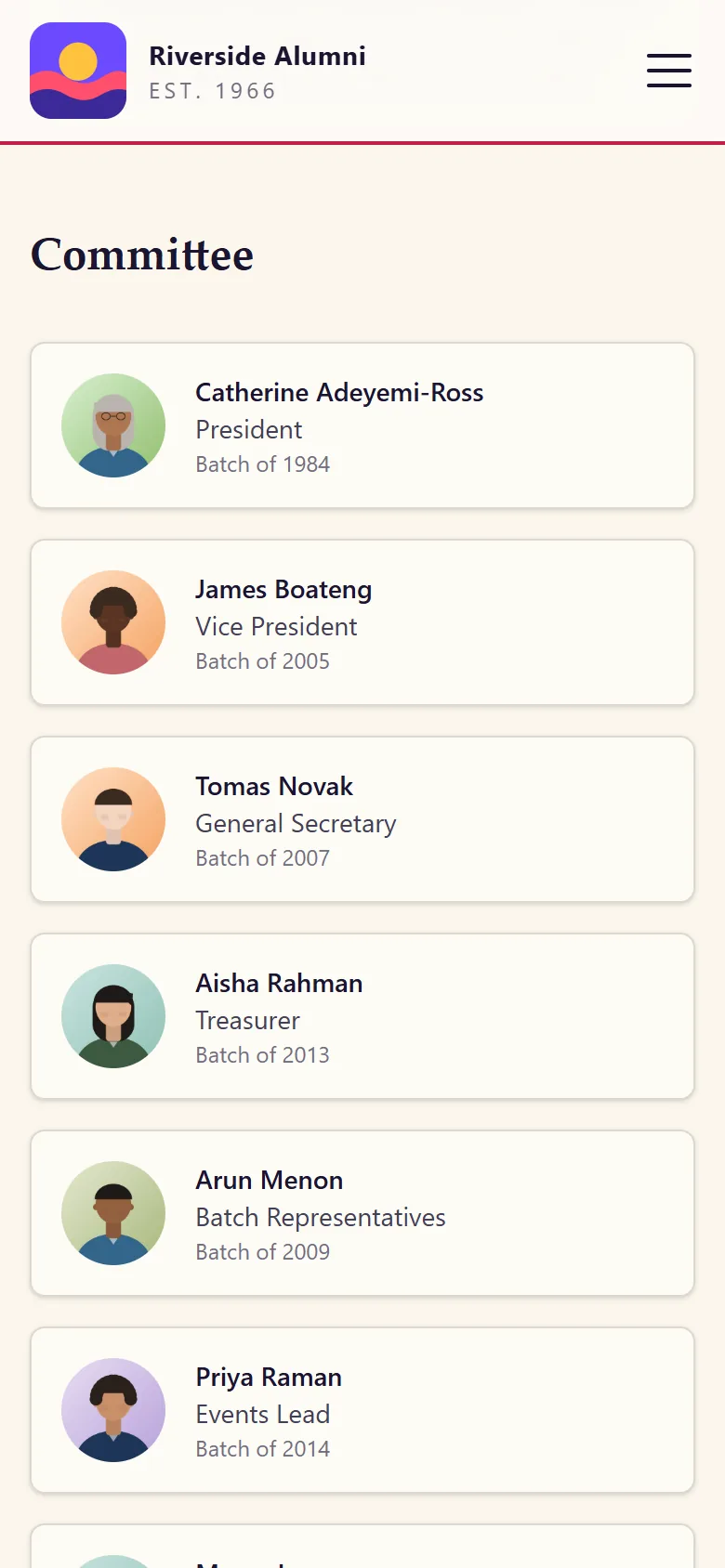
  • A committee roster with photos, roles and class years on the About page
Association documents

Events and email

The AGM and the reunions on one calendar

Publish the AGM, the annual dinner and the class reunions as events. Members answer Yes, Maybe or No, and the notice goes to the members you choose.

  • Capacity and seats left on ticketed events
  • A reminder email to everyone who said Yes, two days before
  • Email a class-year range, a city or an engagement band
Events and RSVP

Membership fees

Subscriptions the treasurer does not have to chase

Membership dues ship switched off. Once you switch them on, you set the tiers the association offers: one that renews every period, a fixed term or life membership, each free or with a price and an optional joining fee. A member picks a tier on the join form or on their Membership page, and pays by card into the association's own account, or by a way you allow, such as bank transfer or cash, which the treasurer marks as paid.

  • Nobody pays before the committee approves them: the joining invoice waits on their Membership page
  • A renewal invoice 30 days before a membership ends, and reminders 30 and 7 days before and on the day, unless you change the days
  • 30 days of grace before a membership counts as lapsed, unless you set another period, with lists for the treasurer of who is expiring, in grace and lapsed
  • Numbered invoices and receipts with a PDF, and a tax line only if you type one in
The member area

Groups and chapters

A chapter in every city, run by its own leaders

Groups are on from the first sign-in. The committee creates each one as a chapter, a region, a club, an interest, an affinity group or a committee, and decides who can see it and how people join: freely, on request or by invitation. From then on its leaders run it from the member area, with no admin login.

  • Leaders answer requests to join, invite members, and make another leader or step down
  • An email to the group is checked and sent by the communications team, 2 for each group in any seven days, unless you change either setting
  • The member list as a spreadsheet, unless you switch that off, holding only the details each member chose to show
  • A discussion room and group news, and meetups the leaders propose for the events team to check
Community forums

The AGM

The committee election, by secret ballot

Elections ship switched off. Once you switch them on, you set the voting window, the positions, the candidates and who may vote: every member, or a range of year groups. Members vote in the member area. The site keeps who voted and what was chosen in two separate places with nothing to join them, so nobody, the committee included, can see how anyone voted.

  • One choice, several choices up to the number of seats, or ranked choice for one seat
  • A second vote is refused, and a vote cannot be changed once it is cast
  • Turnout shows while voting runs; results appear only after it closes and is counted
  • The count is sealed, and "Check the seal" on the results page shows whether anything has changed since
Association documents

Check it yourself

Six facts for the treasurer, each one checkable.

The terms a committee signs up to, in one place, with the page that proves each one.

  • Check it

    $49 a year, in US dollars

    One licence, with every feature and no tiers, sold worldwide.

    Pricing
  • Check it

    One key, one site

    A licence runs one site at one address, with unlimited members and admins on it. No staging copy is included.

    The licence
  • Check it

    A lapse leaves the site up

    Public pages stay online and nothing is deleted. Sign-in pauses 21 days after a missed renewal and returns the day you renew.

    What a lapse does
  • Check it

    14 days, first purchase

    Your first purchase has a 14-day money-back guarantee, for any reason. A renewal is not refundable, and can be cancelled before its date.

    Terms of sale
  • Check it

    Security tests, published

    No independent penetration test has been done. Security is tested in-house, and every finding is listed with its status.

    Read the tests
  • Check it

    A person answers

    Support is through the contact form. We aim to reply within one working day, Monday to Friday: a target, not a guarantee.

    Contact

Sample data in the live demo

Riverside College Alumni Association gets ready for its AGM

The association in the live demo has 130 members, a committee on its About page, the AGM and alumni breakfast in its calendar, and three appeals on the giving page. Sign in as the admin to see what the secretary would see.

Try it in the demo

Your first month

From install to the AGM notice, in four weeks.

A realistic plan for a committee with one person who is at home in a hosting control panel and a few hours a week between everyone else.

  1. Week 1: install it in the association's name

    Buy the hosting and the domain in the association's name: ordinary shared hosting, the kind of web hosting plan many associations already pay for, checked against the hosting requirements. Switch on the ionCube Loader (a tick box in cPanel), upload the zip, create a database and run the six-screen installer. Add the cron line, enter your mail server and send the test email. One evening, for whoever is comfortable in the hosting control panel.

  2. Week 2, first half: make it yours

    Logo, four colours, the site name and the committee roster. Write the About page, put the association's founding on the timeline, and switch off the modules nobody will look after. An empty module looks worse than a missing one.

  3. Week 2, second half: bring in the list you already have

    Import last year's spreadsheet with the CSV wizard: map the columns, read the dry run, then commit. Imported members start outside the directory and hear nothing until you press Invite all from this import, which emails each of them a personal link to choose a password.

  4. Week 3: open the doors

    Post the join link in the group chat and the newsletter. Approve applications in batches, using the vouches and register matches. Each approval emails a set-password link.

  5. Week 4: the AGM, and a login for every post

    Publish the AGM as an event and the notice in the Association section, then email it to members. Give the secretary, the treasurer and the events lead their own accounts, each with only the areas that post needs.

Continuity

The handover file, written before you need it.

Self-hosting works for a volunteer body when everything it depends on is in the association's name and written on one page that passes to the next secretary.

A handover file that fits on one page
WhatWho holds itWhere to find it
Domain and hosting accountThe association, not a memberThe handover file, with the billing contact
AlumDeck licence keyThe associationThe handover file, with the email address it was bought with: the link that moves a licence to a new address is sent there. It renews once a year
Admin accountsOne per committee postAdmin panel, Users: the areas each account holds
Nightly backupsThe hosting account, outside the web folderThe Backups page shows the last run
Modules switched offThe committeeSettings, Modules

The honest part

What it does not do for an association.

  • A payment provider proven with real money. Membership dues and gifts are paid by card into your own Stripe, PayPal or Razorpay account. Stripe is the one that was tested, and only in its test mode; PayPal and Razorpay ship untested.
  • Groups that members start themselves. The committee creates each group or chapter; its leaders then run it.
  • A ruling on your constitution. An election counts the votes the way you set it up, and a tie is left for the committee to settle under your own rules.
  • A staging copy for the next committee to practise on. One licence runs one site, and a test install on a laptop counts as that site.
  • A ready-made translation. Only English ships; another language is wording a volunteer fills in and you import.
  • Two-factor sign-in for members. It is for admin accounts only.
  • Elections and membership dues ready on day one. Both are in the licence and ship switched off, so someone has to switch them on and set them up. Groups and chapters are on from the start.
  • Phone support, or someone to install it for you. Support is through the contact form.

Everything else AlumDeck does not do is on the full list, and what comes next is on the public roadmap.

Questions

What committees ask

We already have a group chat. Why pay for anything?

A group chat is free and everyone is already in it, which is a real advantage. What it cannot give you is a member list the association owns and can export, a check that someone really is an old member, or a site the next committee inherits with the logins intact. If none of that matters to your committee, stay where you are.

Can members pay their subscription through the site?

Yes, once you switch it on. Membership fees are a module that ships switched off: set the tiers and their prices, add the keys of the association's own payment account, and members pay by card on the provider's own page, or by bank transfer if you allow it. The money goes straight to the association's account. AlumDeck never holds it and takes no fee of its own; your payment provider charges its usual fees.

Stripe is the one payment provider that was tested, and only in its test mode, never with real money. PayPal and Razorpay are built in and ship untested. The gaps are on the list.

How many committee logins can we have?

As many as you like; there is no seat charge. Each account gets only the areas it needs out of 13 (events, giving, members, news and so on), each at view, edit or manage level, and a full administrator can switch an account off the day someone steps down. Sign-ins and changes go into an audit log kept for 365 days.

What happens if nobody renews one year?

The public site keeps running: news, events, history and the giving page stay online, and nothing in your database is touched. Administrators see a banner, and 21 days after the renewal date member and admin sign-in pause until the licence is renewed. Renew, press "Check again" on the notice, and sign-in is back the same day.

Does the association need a technical person?

For one evening, yes: someone comfortable in a hosting control panel, who can switch on a PHP extension, upload a zip, create a database and paste one cron line. After that the committee runs it from the admin panel. A new release installs from the Updates screen in two steps, with a rollback copy kept, so the job that remains is holding the hosting login. Keep that person in the handover file.

Our members live all over the world. Does that matter?

Not to your members. They sign in from anywhere, and the timezone, date layout and currency are settings.

One thing does matter. Only English ships: the interface can run in another language, right to left included, but the translation is wording a volunteer fills in and you import. Where the association is based does not: AlumDeck is sold worldwide, at the same $49.

Also for

Not an association? Read the page that fits.

  • Colleges and universities

    An alumni office of two or three people and forty batches. No per-record or per-seat fee.

    For colleges
  • Schools

    One member of staff, a spreadsheet of leavers and a cupboard of photographs. A renewal nobody has to defend.

    For schools
  • Developers and agencies

    Installing it for a client on shared hosting. Requirements, the installer and one licence per client site.

    For developers

See an association running on it.

Sign in to the demo as the admin: members, approvals, the AGM and three appeals are all there. It puts itself back every night.

Sign-in details on the demo pageResets every night

Type a word, or start with one of these pages.

↑ ↓ moveEnter openEsc close